November 2026 edition
A landmark season.
· 4 pages · PDF, 6.2 MB
Two overall victories in Portugal. A podium at Formula Bharat. A season of electric and driverless engineering, built by a team of 120+ students.
Explore the highlights below, or read the complete edition for competition results, subsystem insights, our sponsors and the road ahead.
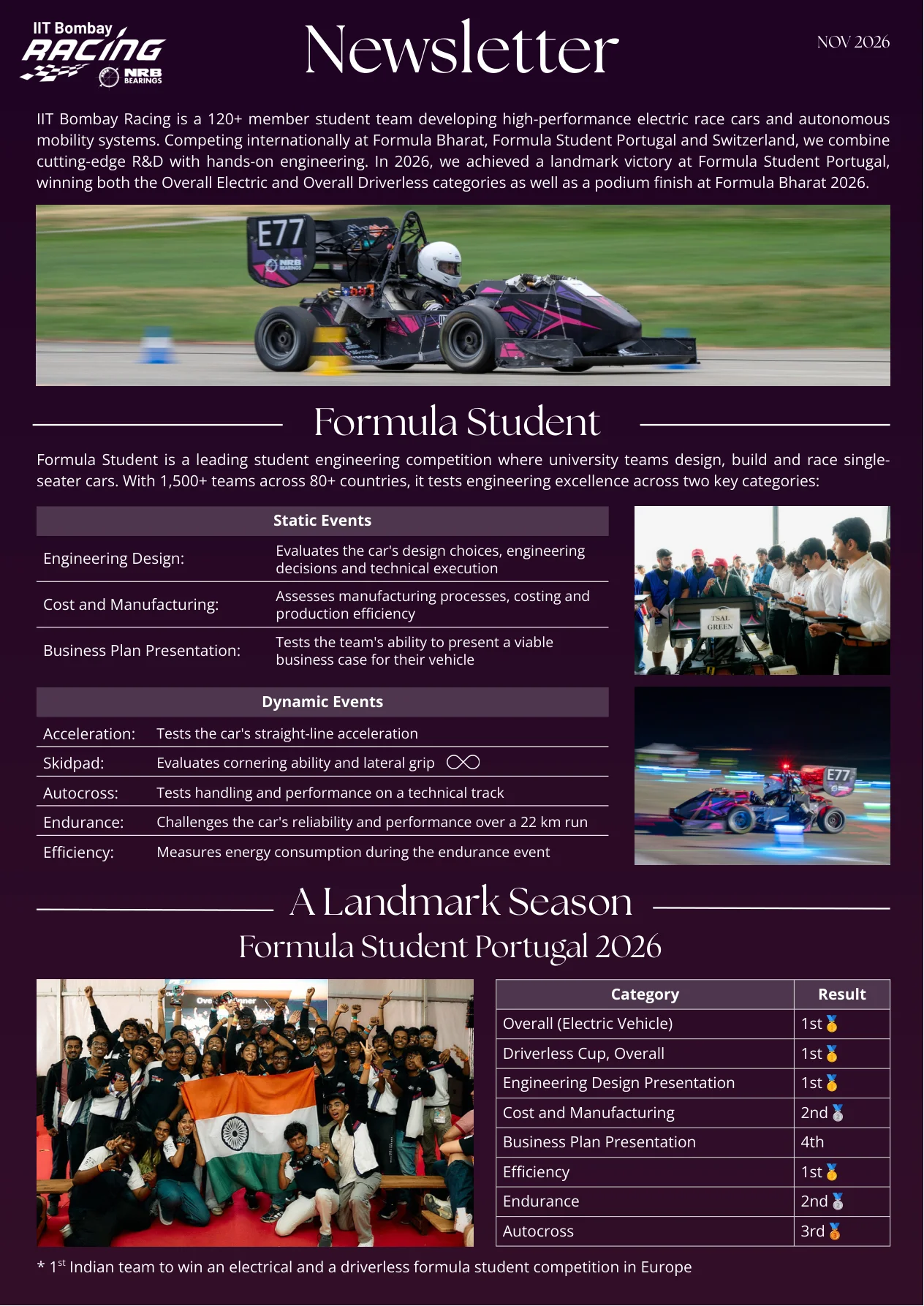
2026 competition recap
A season on the world stage
Formula Student brings design, manufacturing and business presentations together with on-track tests of performance, reliability and efficiency. Here is how our 2026 season unfolded, as reported in this edition.
Formula Student Portugal
1st overall · Electric & Driverless
| Event | Place |
|---|---|
| Overall Electric Vehicle | 1st |
| Overall Driverless Cup | 1st |
| Engineering Design | 1st |
| Cost and Manufacturing | 2nd |
| Business Plan | 4th |
| Efficiency | 1st |
| Endurance | 2nd |
| Autocross | 3rd |
Formula Bharat
3rd overall
| Event | Place |
|---|---|
| Overall | 3rd |
| Statics | 1st |
| Engineering Design | 1st |
| Cost and Manufacturing | 2nd |
| Business Plan | 9th |
Formula Student Switzerland
13th overall
| Event | Place |
|---|---|
| Overall | 13th |
| Business Plan | 8th |
| Acceleration | 7th |
| Skidpad | 9th |
| Design | 17th |
| Cost | 18th |
Beyond the podium
Engineering under pressure
From simulation to the track
During early testing in Leoben, Austria, a steering algorithm fault sent repeated maximum-steering commands to the car. The team traced and fixed it within the same testing session, reinforcing the importance of real-world validation.
Rebuilding far from home
The car travelled overseas disassembled. Reassembly, brake bleeding, dry checks and a broken 3D printer added to the challenge. The team nevertheless completed scrutineering ahead of schedule in both Switzerland and Portugal.
Inside the team
Many disciplines. One race car.
Mechanical
Structural, Powertrain and Dynamics bring together a carbon-fibre monocoque, twin rear-mounted EMRAX motors, a planetary gearbox and simulation-led suspension, braking and steering development.
Electrical
Controls, Communication and Data Acquisition (CCD), Accumulator Management System (AMS) and Electronic System Integration (ESI) connect telemetry, battery monitoring and fail-safe hardware into one vehicle architecture.
Driverless
Perception interprets camera and LiDAR data; SLAM maps the track and locates the car; Path Planning & Controls turns trajectories into driving commands. SIM-DEV tests the stack in a CARLA-based virtual environment.
Business
Business Plan Presentation, Marketing and Operations connect our engineering to the outside world through business analysis, sponsorships, communications, budgets and team coordination.
2026–27 goals
The road ahead
The next chapter builds on this season's lessons. These are development targets outlined in the newsletter.
Developing the next car
- Dual in-hub motors to reduce drivetrain weight.
- A 600V accumulator architecture, up from 400V.
- Optimised components, targeting a 15 kg chassis weight reduction.
- Improved accessibility and rain-test compliance.
Raising performance
- More responsive driverless braking and steering actuators.
- A target driverless average speed above 60 km/h.
- Validation of aerodynamics, torsional rigidity and suspension linkage forces.
- Aiming to win Formula Student AI and Formula Student UK.